You’re standing in the checkout line with a roll of tape, a half-crushed gift bag, and that creeping feeling that your “thoughtful holiday” plan has become “I bought something… technically.” You’re not out of time—you’re out of bandwidth. And that’s a different problem.
Last-minute holiday crafts matter because they solve a very specific, very modern tension: you want to show care, not just spend money, but your calendar is already full and your brain is already tired. The right craft isn’t about being Pinterest-impressive. It’s a way to create a small, tangible signal of attention—quickly, with low risk, and without turning your kitchen into a glitter incident scene.
What you’ll walk away with: a practical decision framework to pick the right craft in minutes, a set of “high-sentiment, low-time” projects that still feel special, and tactics to avoid the mistakes that make last-minute DIY look (and feel) last-minute.
Why this matters right now (and what it actually solves)
Holiday pressure often isn’t about gifts—it’s about relationships. Many of us are trying to maintain connection while juggling a busy life, and gifting becomes a stand-in for “I see you.” When time is short, people default to either:
- Overcompensating (choosing a craft that’s too complex, leading to stress and a mediocre result), or
- Under-signaling (grabbing something generic that doesn’t communicate much beyond “I remembered”).
A well-chosen last-minute craft solves three problems at once:
- Signal clarity: it shows specific attention (not just effort).
- Logistics: it fits your available time, tools, and mess tolerance.
- Emotional risk: it prevents the “I tried to DIY and it looks like a school project” outcome.
Principle: In gifting, the goal isn’t maximum effort—it’s maximum credible care per unit of time.
Behavioral research often frames “thoughtfulness” as being driven by perceived personalization and intentionality. In plain terms: people feel valued when the gift reflects something about them, not when it reflects your ability to craft flawlessly.
The “Special, Not Stressful” Framework (a 7-minute decision tool)
Before you grab supplies, run your idea through this framework. It’s designed for busy adults who want a reliable outcome.
Step 1: Pick your craft category by constraint, not by fantasy
Choose the bucket that matches your real life today:
- No-bake edible (best for speed; high appreciation; moderate packaging needs)
- Useful household (best for “adult special”; lower cuteness, higher longevity)
- Paper + pen (best for low cost and low mess; very high personalization)
- Upgraded store-bought (best for near-zero time; depends on presentation)
- Kid-friendly (best for families; requires realism about attention spans)
Step 2: Score the idea on the 4-point “Actually Works” test
Give each category a quick 1–5 score:
- Time-to-finish: Can you complete it in one focused session?
- Failure risk: What’s the chance it looks sloppy or breaks?
- Sentiment yield: Will the recipient feel “seen” by it?
- Cleanup cost: Will you hate your life afterward?
If any score is under 3, adjust the plan (simplify, choose a different craft, or switch to “store-bought + meaningful wrapper”).
Step 3: Apply one “Personalization Anchor”
Most last-minute crafts fail because they stay generic. Fix that by adding one anchor tied to the recipient:
- A scent they like (citrus, peppermint, vanilla)
- A color that matches their home
- A local reference (neighborhood, shared place, inside joke)
- A “ritual” they already do (tea at night, Sunday cooking, gym bag readiness)
- A preference note (decaf, fragrance-free, spicy, minimal)
High leverage move: One specific detail beats five extra hours of crafting.
Step 4: Decide packaging before you start
Packaging is not an afterthought—it’s the difference between “homemade” and “special.” Decide now:
- Container (jar, tin, paper wrap, envelope)
- Label style (handwritten tag, simple card, printed slip)
- One finishing element (twine, wax seal, sprig, ribbon, tape)
This keeps you from making something nice and then throwing it into a random bag at the end.
Crafts that feel special because they’re useful (and don’t take forever)
These options are designed for high “grown-up appreciation,” low mess, and repeatable success.
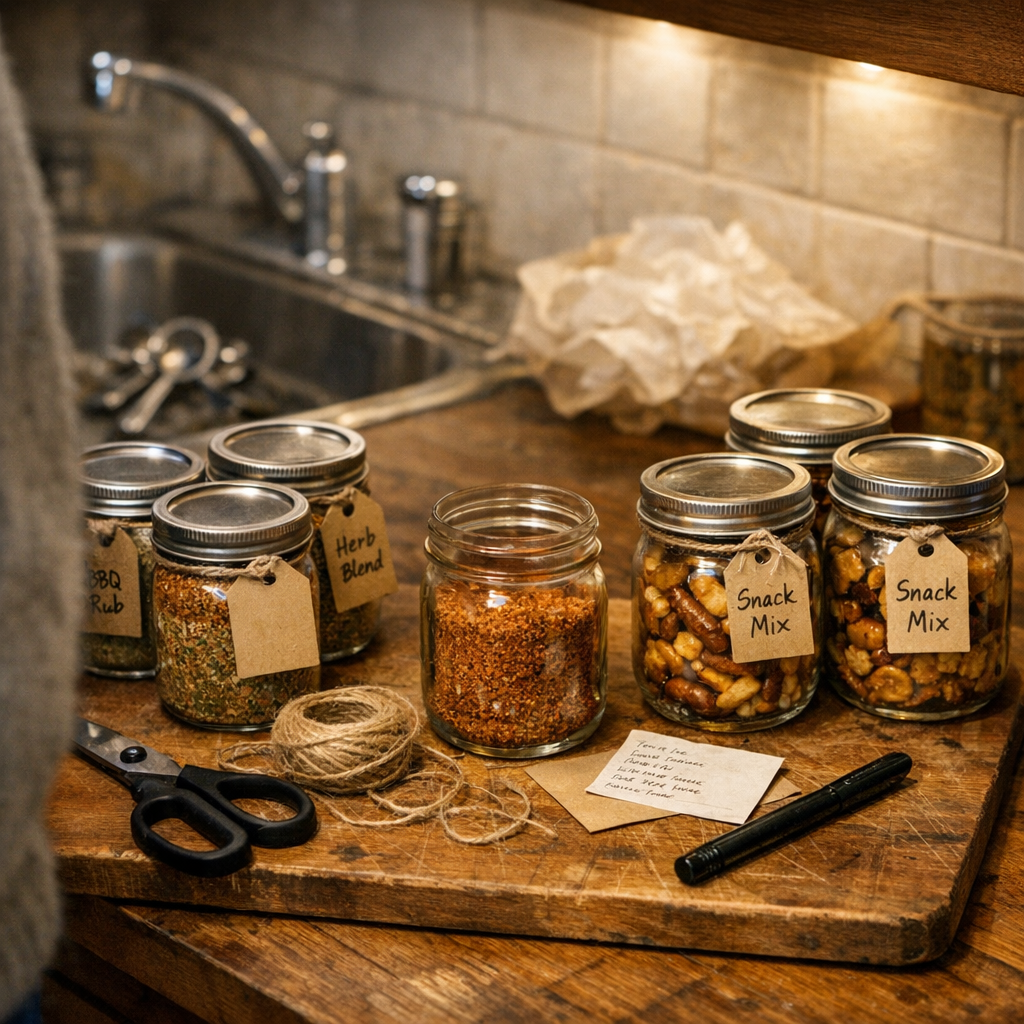
1) “Recipe-in-a-jar” pantry blend with a real use case
Skip the dusty layered cocoa cliché and make something people will actually use. Choose one:
- Taco seasoning blend (smoked paprika, cumin, garlic, oregano, salt)
- Chai spice blend (cinnamon, cardamom, ginger, clove)
- “Weeknight soup starter” (lentils + spices + bay leaf; include a simple recipe card)
- Pancake dry mix (add a note: “Just add milk + egg”)
Why it feels special: it supports a future moment (a meal, a cozy night), not just the gift exchange.
Pro tip from experience: include a one-paragraph instruction card: what it’s for, how much to use, and one substitution. The recipient shouldn’t need to Google anything.
What This Looks Like in Practice
Imagine you’re gifting to a neighbor you like but don’t know deeply. A jar labeled “Smoky Weeknight Taco Blend” + a tiny card: “2 tbsp per pound of protein, great on roasted cauliflower too.” That reads as thoughtful without being intimate.
2) A “small upgrade kit” for a common routine
This is the highest ROI category for last-minute gifting because it’s assembled fast but feels curated.
- Tea kit: two tea bags (or loose leaf), a local honey stick, a dried orange slice
- Desk reset kit: a nice pen, sticky notes, a mini hand cream
- Movie night kit: microwave popcorn + a spice shaker (nutritional yeast or cinnamon sugar) + a small candy
- Travel kit: lip balm, mini lotion, stain remover pen
Packaging: kraft box or small reusable pouch. Add a label that names the ritual (“Tuesday Night Tea,” “Desk Reset,” “Carry-On Calm”).
Behavioral science angle: People value gifts that reduce friction in daily routines. A kit is a friction-reducer with a bow on it.
3) Scented drawer sachets that don’t scream “craft store”
Use plain cotton muslin bags (or make simple sewn rectangles if you have a machine). Fill with:
- Dried lavender + a pinch of rice (bulk + moisture buffering)
- Rosemary + dried citrus peel
- Cedar chips (great for closets)
Add a small tag: “Toss in a drawer; squeeze to refresh.”
Tradeoff: scents are personal. Use this for people you know prefer fragrance, or offer a “light scent” blend.
Edible crafts that don’t require perfection (and won’t collapse in transit)
Last-minute edible gifts succeed when they’re structurally stable. Choose recipes that set firmly and travel well.
4) Chocolate bark with one strong flavor story
Chocolate bark is forgiving and fast, but it often looks chaotic. The fix: limit yourself to one theme.
- Dark chocolate + toasted almonds + flaky salt
- White chocolate + crushed peppermint + lemon zest
- Milk chocolate + pretzel + espresso powder
Technique that changes everything: pour, then tap the tray to level; add toppings in a deliberate pattern; chill; break into large shards (large looks intentional).
Packaging: parchment wrap + twine + a label naming the flavor (naming signals intention).
5) “Better than a cookie” snack jars (sweet or savory)
Build a snack mix that feels adult and specific:
- Savory: roasted nuts + pretzels + smoked paprika + rosemary + a bit of sugar + salt
- Sweet: toasted coconut chips + chocolate-covered almonds + dried cherries
Why it works: no baking, low failure risk, and highly portable.
Overlooked detail: include an allergen note on the tag (nuts, dairy). It’s thoughtful and avoids awkwardness.
Paper-and-pen crafts: the fastest path to “I paid attention”
If you have almost no time and want maximum emotional impact, paper is your friend. People underestimate how powerful a well-structured note can be because it feels “too simple.” It’s not simple—it’s rare.
6) A “micro-memoir” card: three small truths
Write a card with this structure (takes 5–10 minutes, but reads like a lot more):
- One specific memory you appreciate (“That night we fixed the flat tire in the rain…”)
- One trait you genuinely respect (“You stay calm when everyone else spirals.”)
- One forward-looking wish (“I hope next year brings you more quiet weekends.”)
Put it in a simple envelope. Add one small extra: a tea bag, a bookmark, a photo print, or a pressed leaf.
Misconception: “A note isn’t a real gift.” Correction: a note is often the only part people keep.
7) A “choose-your-own evening” voucher that doesn’t feel cheesy
A coupon can feel flimsy unless it’s specific and realistic. Create one card with:
- The exact offer (“I’m taking you to breakfast at X—my treat.”)
- Two date windows (“Pick one: Jan 10–12 or Jan 17–19”)
- One boundary (“1–2 hours, low key.”)
Why it feels special: it removes scheduling friction. You’re not gifting “sometime,” you’re gifting a plan.
Upgraded store-bought: when you need speed but refuse to look careless
Sometimes the correct choice is acknowledging your constraints and doing a high-integrity upgrade. This is not “giving up.” It’s risk management.
8) The 3-layer upgrade that makes anything feel curated
Take one decent store-bought item and add two layers:
- Layer 1: context label (“For your post-work unwind,” “For your Sunday cooking”)
- Layer 2: pairing item (coffee + biscotti, candle + matches, pasta + sauce)
- Layer 3: brief personal note (one sentence only, but specific)
Example: A quality olive oil + a small lemon + a tag: “For your sheet-pan dinners—this one tastes bright.” It’s not a craft, but it carries the same “I noticed” signal.
What This Looks Like in Practice
You realize at 6 p.m. you have a dinner party tomorrow. You buy a small potted herb, tie a simple card with one cooking suggestion, and include a tiny salt. Total time: 15 minutes. It reads like you planned.
A simple decision matrix (use this when you’re tempted to overdo it)
Use this table to choose a craft that matches your reality. Pick the row that fits your constraints best.
| Constraint | Best Craft Type | Why It Works | Watch-Out |
|---|---|---|---|
| Under 30 minutes | Paper-and-pen + small add-on | Max personalization per minute | Don’t write a generic message |
| Low mess tolerance | Curated kit / upgraded store-bought | Clean, controlled assembly | Packaging must be deliberate |
| Needs to travel well | Snack jars / spice blends | Stable, no melting, no bruising | Avoid fragile cookies and frosting |
| Multiple recipients | Batchable consumables | Assembly-line efficiency | Keep variations small (label clearly) |
| Recipient is hard to shop for | Routine-based kit | Practical without being impersonal | Confirm scent/allergy preferences |
Decision Traps That Make “Last-Minute” Look Last-Minute
This is the section that saves you from the common facepalms.
Trap 1: Choosing a craft you’ve never done before
New recipe + deadline is a bad combination. Your stress goes up, quality goes down. If you want novelty, make it in the label or the flavor theme, not the technique.
Trap 2: Mistaking complexity for meaning
A complicated craft can read as self-focused (“look what I made”) rather than other-focused (“this is for you”). Meaning usually comes from relevance, not intricacy.
Trap 3: Ignoring drying/setting time
Many crafts fail because they’re not actually finished when you need them—paint still tacky, chocolate still soft, ink smudging. If it requires curing, drying, or chilling, build that time into the plan.
Trap 4: Forgetting the “final 10%” (label, wrap, note)
The final 10% is what signals care. Without it, even a good item looks like a spare object from your pantry.
Trap 5: Over-scenting or over-sugaring
When people rush, they compensate with “more.” More peppermint, more fragrance oil, more glitter, more sprinkles. Restraint looks confident. If you’re unsure, go lighter and let the label tell the story.
Risk signal: If you can’t describe the gift in one clear sentence (“It’s a ____ for your ____”), it’s probably not cohesive enough yet.
How to execute in one focused session (a practical workflow)
If you have 45–90 minutes and want a clean finish, use this workflow. It’s how you avoid chaos.
1) Set the “no-mess perimeter” first
- Clear one surface
- Put out a trash bowl and one towel
- Lay parchment or an old baking sheet
You’re creating a small production zone. This keeps the project from taking over the whole room.
2) Assemble before crafting (like mise en place)
Gather containers, tags, twine, scissors, tape, and the actual ingredients/supplies. You’re preventing mid-project scavenger hunts.
3) Make first, perfect later
Do the batch work first (mix, fill, pour). Save the “pretty” tasks (labels, ribbons, notes) until the end when you can see what you’re working with.
4) Add the personalization anchor last
This is where you tailor each item: the label name, the note, the color of ribbon, the “pairing suggestion.” It keeps your process efficient and your result personal.
5) Perform a 20-second quality check
- Is it sealed?
- Is it labeled?
- Does it look intentional from 3 feet away?
- Would you feel good receiving it?
If any answer is no, fix that one thing. Do not start a new craft spiral.
The “Special in a Hurry” Checklist
- Pick a craft type that matches your constraints (time, mess, travel, tools).
- Choose one coherent theme (one flavor story, one routine, one purpose).
- Add one personalization anchor (scent, color, ritual, inside joke, preference).
- Plan packaging first (container + label + finishing element).
- Prioritize stability (avoid fragile, melty, or smear-prone items).
- Write a specific note (one memory/trait/wish beats generic cheer).
- Stop at “clean and intentional” (not elaborate and exhausted).
Wrapping it up without losing your mind
Last-minute holiday crafts aren’t a lesser category of gift—they’re a test of judgment. When you choose something stable, relevant, and cleanly presented, the result feels special because it respects both of you: their experience of receiving and your reality of limited time.
If you adopt one mindset shift, make it this: the craft is the vehicle; the thought is the payload. Use the framework, pick a low-risk project, and put your effort into the part people actually feel—clarity, relevance, and a small moment of being seen.
When you’re pressed for time this season, give yourself permission to be strategic. Special doesn’t require perfect; it requires intentional.